Research
Research Themes
Clay–Gel Interfaces for Low-Carbon Construction
This ongoing direction examines how to regulate ion migration, interfacial bonding, mechanical stability, and durability in alkali-activated materials.
Current focus
Developing atomistically informed clay–gel interface models to identify how to program hydration, transport pathways, and long-term interfacial stability.
Mineral Interfaces for Selective Ion Separation
Engineering ion-exchange, hydration, hydrophobic, and photothermal mineral interfaces for the selective separation and recovery of target ions. This work includes rapid Rb recovery by Na-modified attapulgite, clay-controlled hydrophobic agglomeration, flotation-related mineral interfaces, and hydration-controlled li extraction.
Representative publications
- Pan et al. Advanced Science, 2026 — selective lithium recovery via photothermal evaporation and hydration-controlled adsorption.
- Guo et al. Separation and Purification Technology, 2026 — ion-exchange recovery of trace Rb(I) using Na-modified attapulgite.
- Zhan et al. Colloids and Surfaces A, 2019 — hydrophobic agglomeration behaviors of clay minerals regulated by siloxane structure.
Electrocatalytic and Electrochemical Recovery of Trace Critical Metals
Creating catalytic and electrochemical interfaces that couple adsorption, charge transfer, and reduction for efficient recovery of gold and rare earth elements at trace concentrations. Key advances include heterojunction-enabled photocatalytic reduction, pore-confined electric-double-layer regulation, and chemisorption–electrosorption coupling for rare-earth recovery and separation.
Representative publications
- Zhan et al. ACS Nano, 2024 — chemisorption and electrosorption coupling for trace rare-earth recovery.
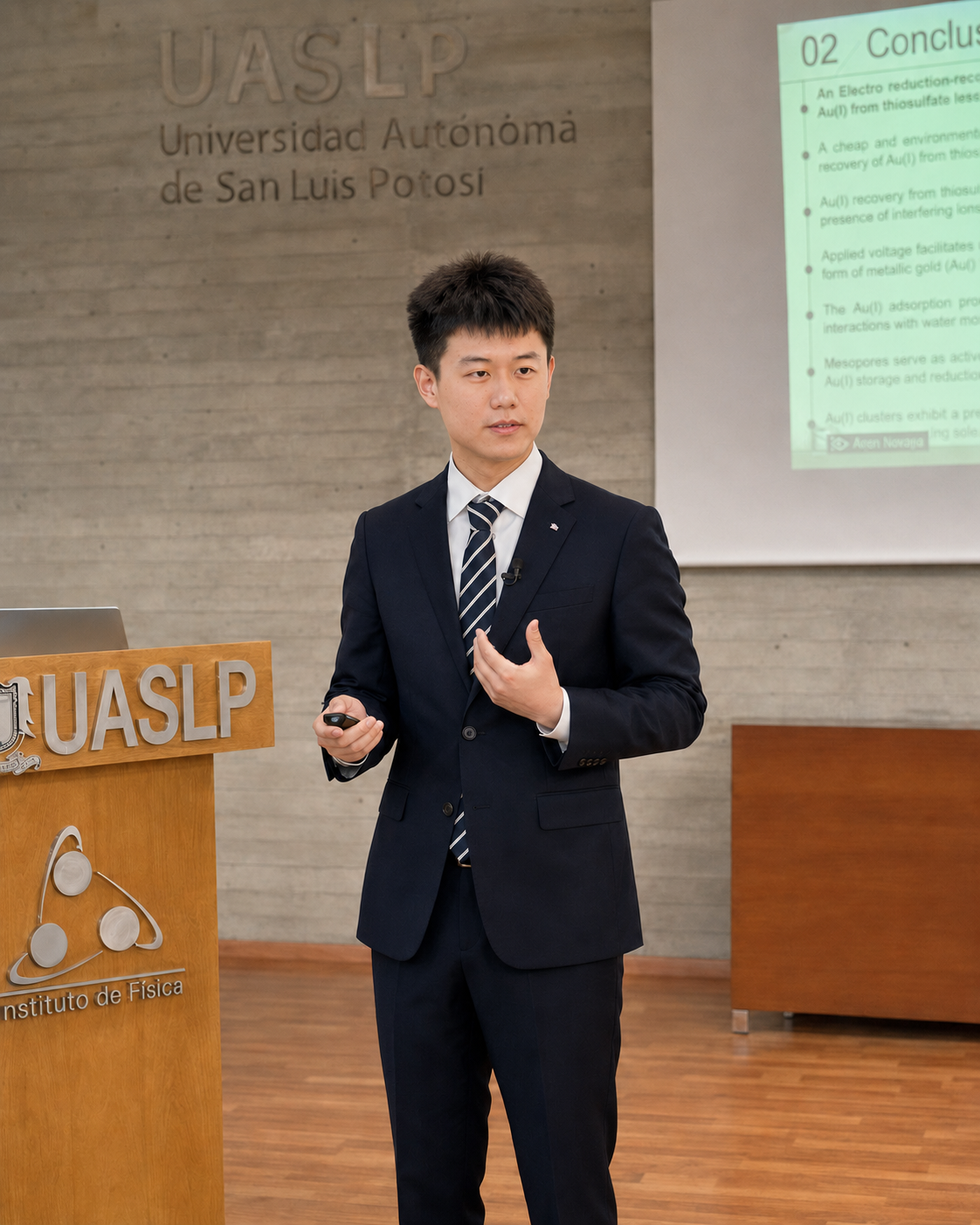
- Weng et al. Carbon, 2025 — electrochemical reduction and recovery of trace gold(I) from thiosulfate leaching solutions.
- Zhan et al. Chemical Engineering Journal, 2020 — ZnS-doped MoS₂ heterojunctions for in-situ photocatalytic gold recovery.
Multiscale Modelling of Mineral–Solution Interfaces
Using LAMMPS, Materials Studio, VASP, and COMSOL to connect atomistic adsorption, hydration, ion transport, and interfacial bond formation with macroscopic separation and reaction processes. Ongoing work integrates ReaxFF, ClayFF, DFT, molecular dynamics, and continuum modelling.
Representative publications
- Zhan et al. Applied Clay Science, 2024 — molecular dynamics and DFT analysis of carboxymethyl cellulose interactions with talc.
- Pan et al. Desalination, 2025 — computational strategies for lithium chemical and electrochemical adsorption.
- Yuan et al. Colloids and Surfaces A, 2018 — molecular dynamics study of cation hydration in electrolyte solutions.